Every repetition you perform has two halves: you lift the load, then you lower it. Understanding the difference between those two phases, the concentric vs eccentric contraction, is one of the highest-leverage things you can learn about strength training. Most of your potential for muscle and strength is hiding in the lowering half, and it happens to be the half that ordinary weights load the worst.
The two phases of every rep
A muscle contraction is concentric when the muscle is actively producing force while shortening in length. Think of curling a dumbbell from your thigh up to your shoulder, pressing a bar off your chest, or standing up out of the bottom of a squat. The muscle is working and getting shorter at the same time. Lifters often call this the "positive."
An eccentric contraction is the opposite. The muscle is still actively producing force, but it is lengthening rather than shortening. Lowering that same dumbbell back to your thigh, returning the bar to your chest, or descending into a squat are all eccentric contractions. The muscle resists the load while stretching out under tension. Lifters call this the "negative."
In normal weight training you pair one of each into a single repetition: a concentric to raise the load and an eccentric to lower it. Both are forms of active muscle contraction, and grasping the two main muscle contraction types is the foundation for everything that follows. (There is a third type, the isometric contraction, where the muscle produces force without changing length, but it is the lifting and lowering phases that drive most training.)
Why the eccentric phase is so different
Concentric and eccentric contractions are not just mirror images of each other. They place fundamentally different demands on the muscle:
- You can produce more force eccentrically than concentrically. Your muscles are simply stronger when lowering a load than when lifting it, which means the lowering phase can generate greater mechanical tension, one of the primary triggers for strength and growth.
- The concentric phase is the more metabolically demanding of the two. It consumes more oxygen and drives metabolic stress, which contributes its own part of the training stimulus.
- The eccentric phase causes more disruption to the muscle fibers themselves. That controlled, microscopic damage is a normal and necessary part of how muscle rebuilds bigger and stronger.
A useful way to hold the distinction in your head: the concentric is more of a metabolic event, while the eccentric is more of a mechanical event. Both matter, but if you are chasing strength and size, the mechanical side carries outsized weight.
Why the eccentric drives the biggest gains
Put those facts together and a clear conclusion emerges. Because you are stronger when lowering, and because the lengthening contraction creates both high tension and meaningful fiber disruption, the eccentric contraction is where a large share of your strength and muscle-building potential lives.
This is why deliberately emphasizing the lowering phase, slowing it down, or performing negative-focused work tends to produce a powerful adaptation. You are leaning into the half of the rep that your body can load the heaviest and that signals the loudest for growth. For a deeper look at why coaches obsess over this phase, see our companion article on eccentrics and what the big deal is.
Why free weights under-load the eccentric
Here is the catch. To actually overload the eccentric, you would need to lower more weight than you lifted. But a dumbbell, barbell, or weight stack is a single fixed number. The load on the bar is capped by what you can raise concentrically, which is the weaker of your two capacities.
That creates an unavoidable mismatch. On every rep with a free weight, the lowering phase is lighter than your muscles could actually handle, because it has to use the same load your weaker concentric just lifted. The eccentric is left under-loaded. And you cannot simply add more plates to fix it, because the moment you load enough to challenge the eccentric, you can no longer complete the concentric to get the weight moving in the first place.
So weights leave you in a bind: they are either too light for your eccentric or too heavy for your concentric, and frequently both within the same set. We unpack this trade-off in detail in our comparison of ARX vs. free weights.
How ARX overloads the eccentric every rep
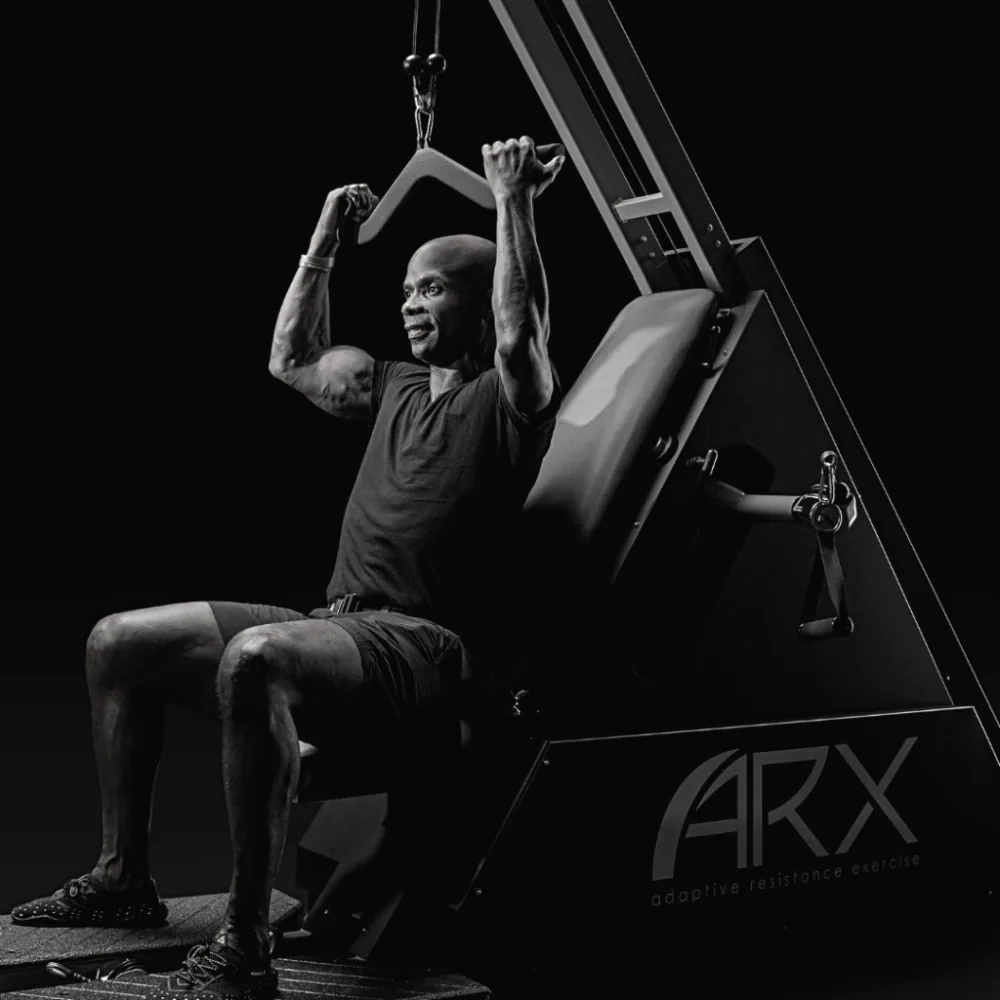
This is exactly the problem ARX was built to solve. ARX machines use patented, computer-controlled Adaptive Resistance™. Instead of a fixed weight, a motor matches resistance to your exact force through the entire range of motion, the concentric and the eccentric alike.
Because the resistance is generated by the motor rather than by gravity, it is not locked to a single number. As you move into the lowering phase, the machine supplies the additional resistance your muscles are capable of handling eccentrically, without making the lifting phase impossible to complete. In practical terms, every rep can load the concentric appropriately and overload the eccentric, instead of forcing you to choose between them. Force data is captured on every single rep, so the effort is measured rather than guessed.
There is a safety dividend too. The resistance only ever responds to the force you yourself apply, so unlike a barbell, there’s never a load you can’t control, and there are no weights to drop. That combination of a fully loaded eccentric and very low injury risk is difficult to reproduce with any stack of plates.
The takeaway
Concentric is the lifting phase, eccentric is the lowering phase, and the eccentric is where an outsized share of your strength and muscle gains is waiting to be unlocked. The reason most people never tap into it is that conventional weights physically cannot load the lowering phase to its potential. Adaptive Resistance Exercise™ removes that ceiling, matching your strength through the whole rep and overloading the eccentric every time, which is a meaningful part of why ARX members see results so efficiently.
Frequently asked questions
What is the difference between concentric and eccentric contractions?
A concentric contraction is the lifting phase, where the muscle produces force while shortening, such as curling a weight up. An eccentric contraction is the lowering phase, where the muscle produces force while lengthening, such as lowering the same weight under control. Most exercises pair one of each into a single repetition.
Why is the eccentric phase so important for building muscle and strength?
Muscles can produce more force eccentrically than concentrically, so the lowering phase allows for greater mechanical tension and more muscle-fiber disruption, two of the primary drivers of strength and hypertrophy. Deliberately emphasizing the eccentric tends to produce a stronger adaptation than focusing on the lifting phase alone.
Why don't free weights load the eccentric phase well?
A free weight is capped by what you can lift concentrically, but you are far stronger eccentrically. Because the load is fixed, the lowering phase is always lighter than your muscles could handle, so the eccentric is under-loaded on every rep. Adding more plates to challenge the eccentric makes the concentric impossible to lift.
How does ARX overload the eccentric on every rep?
ARX uses computer-controlled Adaptive Resistance™. A motor matches resistance to your exact force through the full range of motion, including the lowering phase, so it can supply the extra resistance your muscles can handle eccentrically without making the lifting phase impossible. Force data is captured on every rep, and there are no weights to drop, so injury risk is very low.
See a fully loaded eccentric for yourself
Book a call and feel what it's like when every rep is matched to your exact strength, lifting and lowering alike.
Talk to ARX